
1. Market Overview & Growth Drivers
The CNC machining industry stands at a pivotal inflection point in 2026. The global market now exceeds $100 billion, buoyed by a compound annual growth rate of 7.1% from 2020 through 2026. This growth trajectory reflects far more than simple economic recovery—it signals a structural shift in how precision manufacturing operates and how competitive pressures have reshaped the sector.
Several macro factors are driving this expansion. First, aerospace and defense budgets remain elevated as geopolitical tensions persist. Commercial aircraft deliveries have fully normalized post-pandemic, creating strong demand for aerospace-grade components. Second, the automotive sector's electrification wave has not reduced machining demand; instead, it has redistributed it. Electric vehicle powertrains, battery housings, and thermal management systems require precision machining at scale. Third, medical device manufacturers continue to tighten tolerances and increase production volumes as aging populations globally drive orthopedic, cardiovascular, and diagnostic device demand.
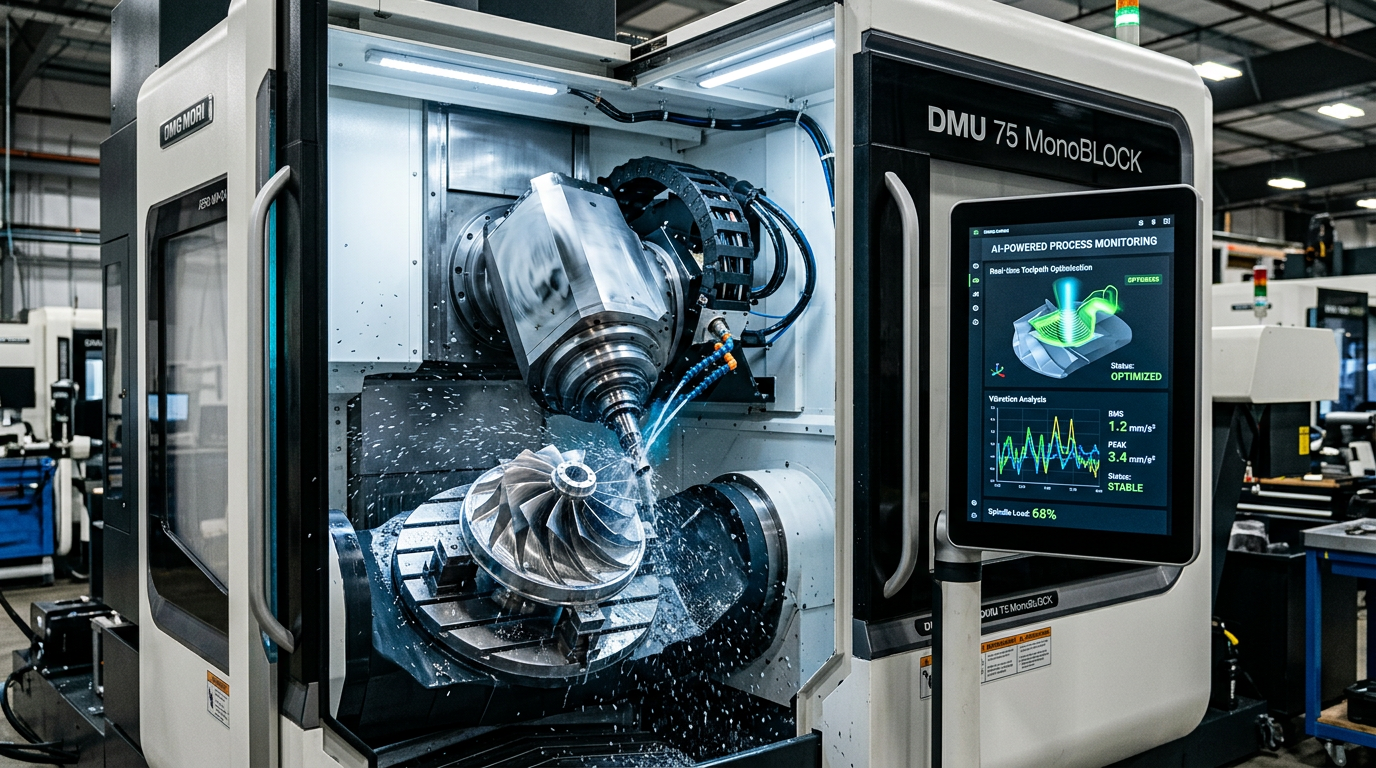
Fourth, and perhaps most strategically significant, reshoring and nearshoring initiatives accelerated by supply chain vulnerabilities have brought manufacturing capacity back to North America and Europe. This has increased the per-capita capital expenditure in machine tools and supporting automation infrastructure. Finally, the push to achieve net-zero carbon goals by 2050 has prompted manufacturers to invest in more efficient machines and lights-out operations that reduce energy consumption per part produced.
Market Opportunity
The $100B+ global CNC market is growing at 7.1% CAGR, with strong demand from aerospace, automotive (EV transition), and medical device sectors. Reshoring initiatives and net-zero carbon investments are accelerating investment in new equipment and automation infrastructure across North America and Europe.
2. AI Is No Longer Experimental
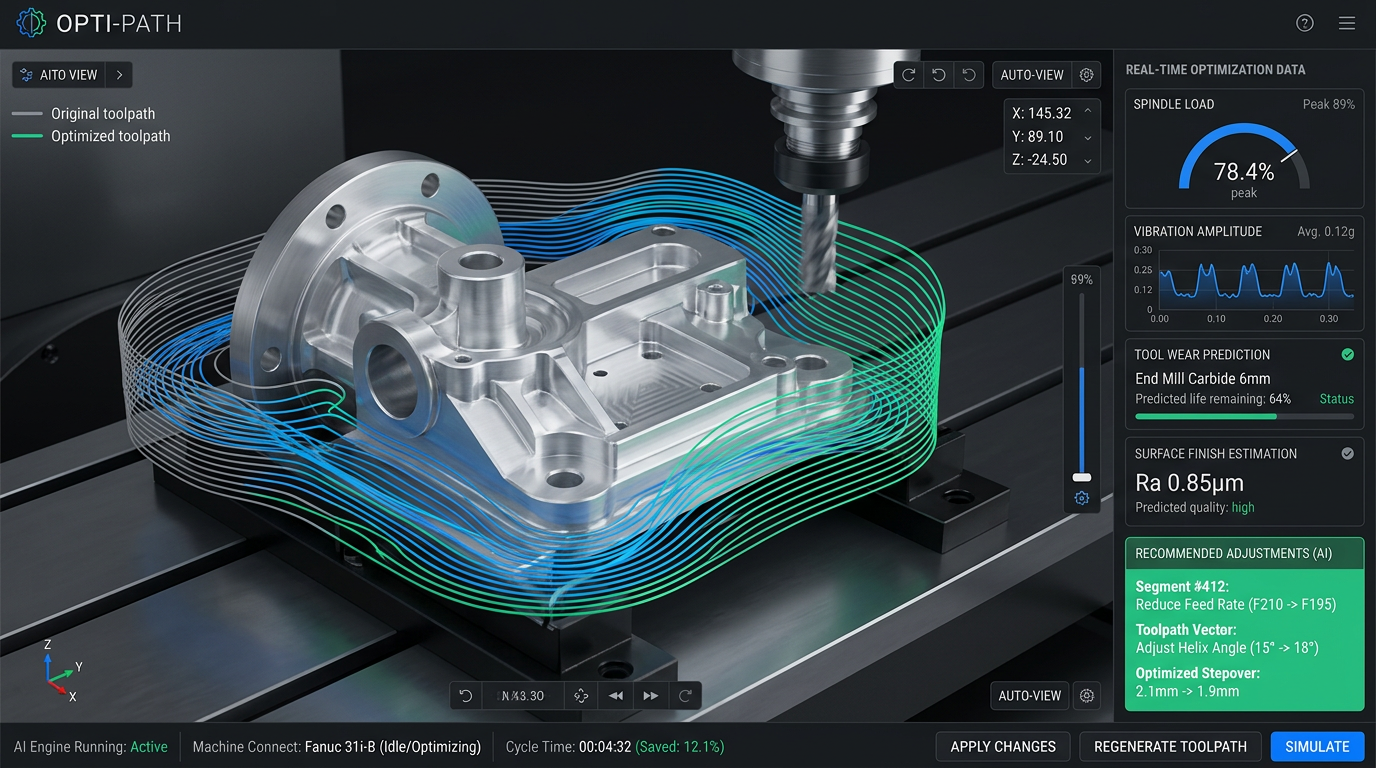
Perhaps the most significant transformation underway in CNC machining is the integration of artificial intelligence into the control loop—not as a bolt-on analytics layer, but as a core operational element. In 2026, real-time sensor feedback continuously adjusts feeds, speeds, and toolpaths without human intervention. Machine learning models ingest data from spindle motors, tool accelerometers, thermal sensors, and vision systems, then dynamically optimize performance across the entire tool life cycle.
Tool wear prediction has emerged as the killer application for AI in machining. Traditional approaches rely on predetermined tool life limits based on conservative statistical models. In contrast, AI-driven monitoring analyzes acoustic emissions, cutting forces, and spindle power consumption to predict tool failure within a few percent accuracy—sometimes days or weeks before traditional indicators would trigger replacement. This capability translates directly to reduced scrap rates, fewer mid-cycle tool changes that disrupt production, and extended tool life that can be exploited through controlled adaptive cutting strategies.
Tool Wear Prediction Benefits
Analyzes acoustic emissions, cutting forces, and spindle power to predict tool failure days or weeks in advance. Reduces scrap rates, eliminates mid-cycle tool change disruptions, and enables extended tool life through controlled adaptive strategies with 80-85% accuracy.
Predictive Maintenance Impact
Anomaly detection algorithms flag bearing failures, spindle imbalances, and servo degradation weeks in advance. One aerospace supplier reduced unplanned downtime by 60% over 18 months through AI-enabled predictive maintenance implementation.
Predictive maintenance has become commonplace. Anomaly detection algorithms trained on years of historical telemetry from similar machine platforms now flag imminent bearing failures, spindle imbalances, and servo performance degradation with 80-85% accuracy weeks in advance. This has allowed forward-thinking shops to eliminate emergency downtime and the costly expediting that accompanies unexpected stoppages. One major aerospace component supplier reported that AI-enabled predictive maintenance reduced unplanned downtime by 60% over an 18-month implementation period.
Edge-based AI deployment—where models run directly on the machine controller or a nearby industrial edge device—has solved the latency and data privacy concerns that hindered early AI adoption. Shops no longer need to stream gigabytes per hour of raw sensor data to cloud platforms. Instead, processed insights and alerts flow to a central dashboard while sensitive production data remains on-premise. This architectural shift has accelerated adoption among manufacturers concerned about intellectual property protection and supply chain confidentiality.
Traditional CNC Operation
- Tool Life: Pre-set limits based on tables and operator experience
- Speed/Feed: Static, conservative parameters
- Downtime: Unplanned failures common; reactive troubleshooting
- Monitoring: Periodic checks by operator
- Optimization: Manual trial-and-error process
- Staffing: Continuous operator presence required
AI-Augmented Smart Shop
- Tool Life: Predictive models adjust in real-time based on conditions
- Speed/Feed: Adaptive control optimizes within material and machine limits
- Downtime: Predictive maintenance prevents 60-80% of failures
- Monitoring: Continuous automated sensing and alerts
- Optimization: Automatic process refinement via machine learning
- Staffing: One technician oversees multiple cells remotely
3. Lights-Out Manufacturing Goes Mainstream
Lights-out manufacturing—the ability to run unattended production for extended periods—has transitioned from a luxury of large aerospace suppliers to an achievable goal for mid-market shops. While pure 24/7 fully autonomous operations remain limited to highly repetitive, low-mix scenarios, the industry has developed a more nuanced and practical approach: extended-shift autonomous operations with human supervision during planned intervals.
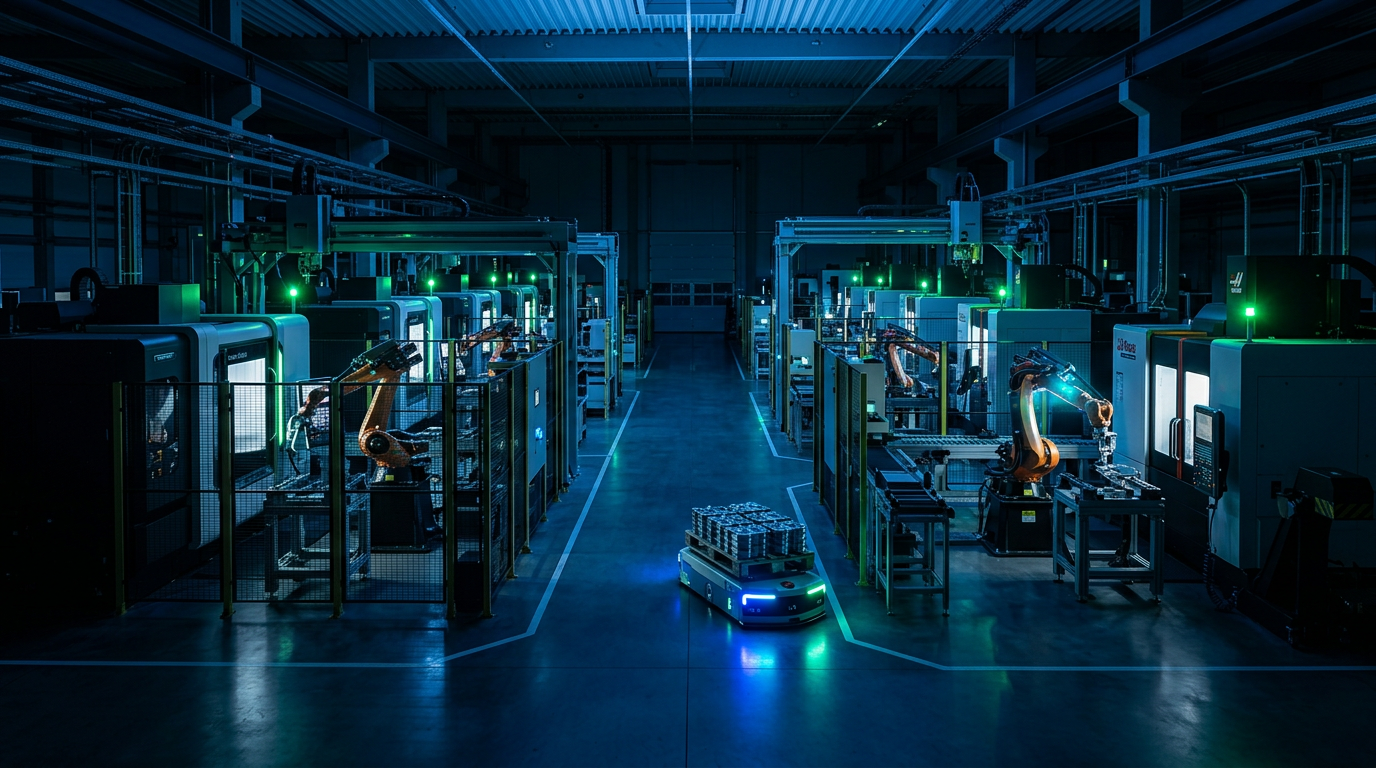
Modern lights-out cell architectures combine several enabling technologies. Automated pallet changer systems with storage carousels enable overnight production runs of 200-400 parts without operator intervention. Self-calibrating tool presetters eliminate the touch-and-probe steps that traditionally required an operator presence. Robot-tended cells handle part loading and unloading with vision-guided gripper systems that adapt to part geometry variations. In-process inspection via vision systems or portable CMM arms catches defects immediately, enabling instant feedback loops that prevent scrap propagation.
Key Insight: Labor Crisis as Automation Accelerant
With 25% of skilled machinists nearing retirement and insufficient apprenticeship pipelines, lights-out manufacturing has become existential. A single skilled operator in California now costs $70,000-$85,000+ annually. A $2.5M lights-out cell displacing two operators pays for itself in under 18 months while providing 24/7 capacity.
The labor equation has become the primary driver of lights-out adoption. With 25% of the skilled machining workforce approaching retirement age and new apprenticeships insufficient to offset departures, shops face an existential choice: invest in automation or accept capacity constraints. Lights-out operations don't eliminate the need for skilled technicians—they redirect it from repetitive machine tending to higher-value troubleshooting, process engineering, and quality assurance. One mid-market shop reported that implementing lights-out operations on three 5-axis machines freed up two full-time equivalent operators who were redirected to process improvement projects that yielded a 15% cycle time reduction across the remaining manual cell.
If you're evaluating AI solutions for your shop, start with tool wear prediction on your highest-volume, most expensive cutting tools. The ROI proof point is usually established within 3-6 months. Next, layer in basic anomaly detection on your oldest machines—these often have the poorest baseline data quality, but also the greatest potential upside in terms of eliminated downtime. Finally, work toward integrating predictive maintenance across your fleet. Don't attempt to boil the ocean with real-time adaptive feeds and full lights-out automation before establishing foundational data quality and operator confidence. Phased implementation reduces risk and builds organizational capability incrementally.
4. Digital Twins and Connected Systems
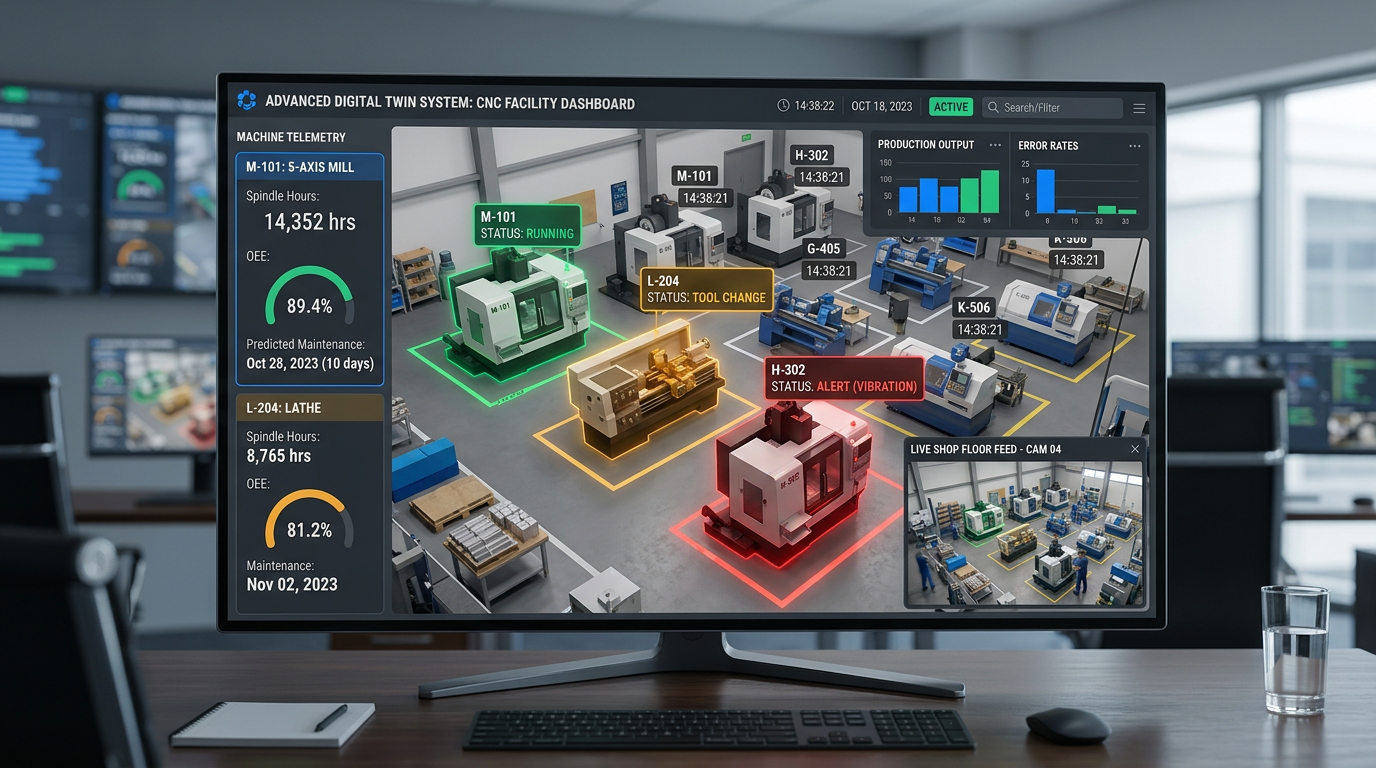
The concept of a digital twin has matured significantly since its introduction. In 2026, a digital twin in the context of precision machining refers to a dynamic virtual replica of a physical machine or production process that continuously syncs with real-world operational data. Unlike earlier implementations that were primarily static simulation tools, modern digital twins are living, evolving models that integrate design data, process parameters, machine telemetry, and quality results into a single coherent representation.
A well-constructed digital twin enables several critical capabilities. First, it allows engineers to simulate process variations and machine parameter changes in a virtual environment before committing to physical hardware trials. A 5-axis aerospace part that might require three or four physical trials to dial in can now be optimized in simulation, reducing the time to production and the cost of material scrapped during ramp-up. Second, it enables predictive performance modeling—by feeding current machine condition data into the twin, operators and engineers can forecast how part quality will degrade if maintenance is deferred another week, or how a bearing failure will propagate across subsequent parts.
Simulation & Optimization
Virtual environment allows engineers to test process variations and machine parameter changes before hardware trials. Reduces material waste during ramp-up and accelerates time-to-production for complex aerospace components.
Process Archaeology
Forensic analysis by replaying machine motion profiles, tool temperature history, and vibration signatures through the digital twin. Pinpoints root causes of quality failures in hours rather than days.
Third, digital twins facilitate what's called "process archaeology"—the forensic analysis of why a particular batch of parts failed quality inspection. By replaying the machine's motion profile, tool temperature history, spindle vibration signature, and material lot traceability through the digital twin, quality engineers can pinpoint root causes in hours rather than days. This is especially valuable for high-value components where scrap can cost thousands of dollars and customer impact is severe.
The ecosystem around digital twins is maturing rapidly. Cloud platforms from Siemens (NX), Autodesk (Fusion Manufacturing), and specialized startups like 5-axis and Xometry now offer plug-and-play integration with major CNC controllers, allowing shops to construct digital twins with minimal custom development. The data architecture challenge—ensuring that design data, CAM files, actual machine instructions, real-time telemetry, and quality results stay synchronized—remains non-trivial, but containerized software and IIoT-powered analytics platforms have made it increasingly accessible to shops without large IT departments.
5. Reshoring and the Labor Equation
Reshoring of precision manufacturing has accelerated sharply since 2023, driven by a confluence of supply chain fragility, tariff structures, and geopolitical risk. While offshore manufacturing in Asia will remain substantial, the strategic shift toward nearshoring in Mexico and onshoring in the United States and Canada is unmistakable. For CNC machine shops, this represents both opportunity and challenge.
The opportunity is straightforward: demand for domestic capacity has increased faster than existing shops can absorb, creating pricing power and lead time advantages for well-run facilities. New Airbus and Boeing capacity projects in North America, the CHIPS Act incentives for semiconductor equipment and advanced packaging, and automotive EV supply chain localization have all created sustained demand pull. Shops with the capital to invest in new equipment, AI monitoring, and lights-out infrastructure have captured premium contract manufacturing work and long-term volume commitments.
Reshoring Opportunity Window
Domestic capacity demand has outpaced supply, creating pricing power and lead time advantages. Aerospace (Airbus/Boeing expansion), semiconductor (CHIPS Act), and automotive EV supply chain localization are driving sustained demand. Well-capitalized shops with AI and automation are winning premium contracts.
The challenge is equally direct: the labor shortage is acute and persistent. The Bureau of Labor Statistics projects that the manufacturing sector will face a cumulative shortfall of 350,000-500,000 skilled workers by 2030. For precision machining, the situation is more severe—machining is a specialized trade that requires 4-6 years of practical experience to develop true expertise. The apprenticeship pipelines in many states have not kept pace with retirements, and younger workers are increasingly drawn to software, robotics, and engineering disciplines rather than manual trades, even as digital skills in manufacturing become increasingly valuable.
This labor crisis is the primary accelerant of automation investment. Shops are not pursuing lights-out manufacturing because it's trendy or to eliminate costs, but because they literally cannot find operators to run multiple shifts. In regions where labor supply is tightest—Southern California, Massachusetts, upstate New York—investment in AI-monitored, robot-tended cells has become non-discretionary. One shop owner in California noted that a single full-time CNC operator now costs $70,000-$85,000 annually in salary plus benefits, plus another $15,000-$20,000 in training and ramp-up time. A 5-axis lights-out cell that costs $2.5 million upfront but displaces two operators pays for itself in under 18 months while providing more consistent 24/7 capacity.
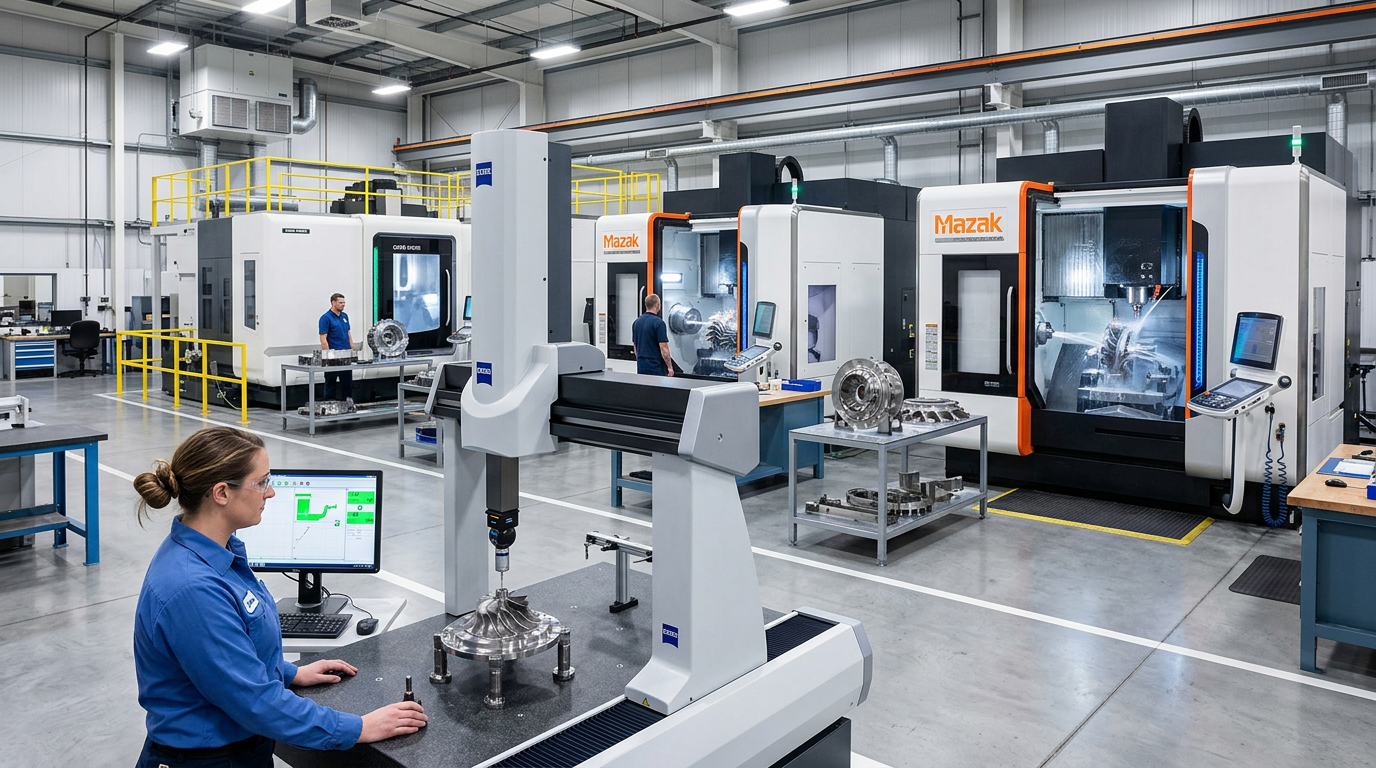
This economic calculus is reshaping the competitive landscape. Shops that invested early in automation now have lower effective labor costs per part, which can be deployed either as margin enhancement or as pricing advantage to win new business. Shops that delayed automation are now facing a squeeze: they can't find people to staff new capacity, and their unit economics are deteriorating relative to better-capitalized competitors.
6. Multi-Axis and Hybrid Machining
The CNC machine tool industry has continued its decades-long migration toward higher-axis-count machines and integrated manufacturing processes that combine multiple material removal and forming technologies. In 2026, 5-axis machines are no longer premium equipment but an increasingly common baseline for job shops pursuing high-mix, low-volume aerospace and medical work.
The technological drivers are well-established. Five-axis machining enables single-setup part geometry that previously required multiple fixturing operations, reducing setup time and part handling—both significant sources of human labor and variability. Simultaneous 5-axis cutting strategies, where the tool moves linearly and rotationally at the same time, enable more efficient paths through complex geometry and often result in better surface finish and tool life compared to positional 5-axis indexing.
5-Axis Advantages
Single-setup part geometry reduces setup time and handling variability. Simultaneous 5-axis cutting enables more efficient toolpaths, better surface finish, and improved tool life compared to positional indexing methods.
Hybrid Integration
Turning, milling, and high-speed grinding combined in single machine setup. Laser marking, annealing, and vision-guided inspection eliminate outsourced steps and enable closed-loop compensation for consistent tolerance across long runs.
Beyond pure CNC milling, the industry is seeing integration of complementary processes. Hybrid machines that combine turning, milling, and high-speed spindle grinding in a single setup are becoming more common in job shops that previously required sub-contracted finishing operations. Laser marking and annealing stations integrated into 5-axis centers eliminate separate outsourced steps. Vision-guided inspection systems with on-machine probing allow closed-loop compensation that keeps parts in tolerance without operator adjustment across long production runs.
The economic case for multi-axis investment has shifted in favor of smaller shops. Twenty years ago, a production-grade 5-axis mill cost $800,000-$1.2 million. Today, capable 5-axis machines are available in the $350,000-$550,000 range, and more importantly, the ecosystem of CAM software, post-processors, and training has matured to the point where a mid-market shop can operationalize 5-axis capability without massive internal engineering overhead. Cloud-based CAM platforms have democratized access to best-practice toolpath strategies that were previously available only to large OEMs with dedicated process engineering teams.
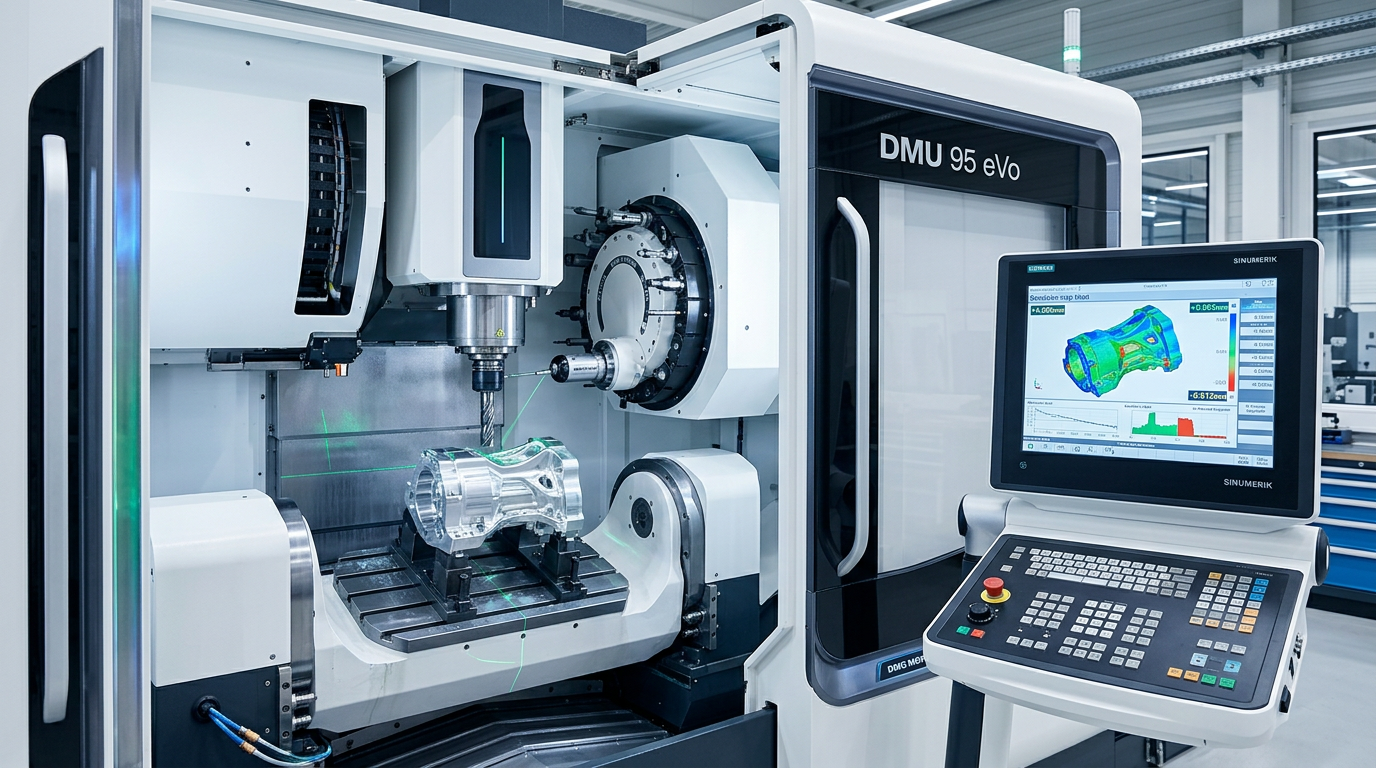
As CNC machines become increasingly connected via Ethernet, cellular, and industrial IoT networks, cybersecurity risks have escalated from theoretical to material. Ransomware attacks on manufacturing facilities that disable CNC controllers and steal production data have caused millions in losses across the industry. Your connected smart shop requires cybersecurity architecture: network segmentation, firewall rules that isolate the OT (operational technology) environment from corporate IT, regular firmware updates on controllers, and monitoring for suspicious data exfiltration. Many shops remain vulnerable because they focus on productivity gains from connectivity while neglecting defensive posture. Engage with your machine tool OEM's security team and consider cybersecurity insurance as production capacity becomes dependent on uninterrupted network access.
7. What This Means for Machine Shops
The convergence of AI integration, lights-out manufacturing, digital twins, labor shortages, and multi-axis technology is fundamentally reshaping the economics and competitive dynamics of CNC precision manufacturing. Shops must navigate this transformation strategically, recognizing that staying the course with traditional approaches is becoming less viable.
Capital Allocation Priority
Shops winning in 2026 made decisive investments in automation and AI during 2023-2025, with 18-36 month payback periods. Fully integrated lights-out cells require $4-6M upfront investment. Shops that delayed now face difficult choices between catching up or accepting reduced capacity and margins.
Workforce Strategy Realignment
Talent competition has shifted from operators to process engineers, data analysts, and optimization technicians commanding $65,000-$80,000 annually. One skilled technician can oversee four to five automated cells, creating favorable unit economics versus legacy labor-intensive approaches.
Capital Allocation Priority: The shops winning in 2026 are those that have made decisive capital investments in automation and AI in the 2023-2025 window. These deployments typically payback in 18-36 months, creating a widening competitive moat. Shops that delayed these investments now face the difficult choice of catching up quickly or accepting reduced capacity and margins. The capital requirements are non-trivial—a fully integrated lights-out cell with robot loading, tool management, inspection, and AI monitoring can easily reach $4-6 million. But the alternative, attempting to compete on traditional labor-intensive operations against better-capitalized competitors with lower effective labor costs, is increasingly untenable.
Workforce Strategy Realignment: The war for talent has shifted dramatically. Rather than seeking operators who can run a machine for eight hours, shops now need to attract and retain process engineers, data analysts, and technicians who can program, troubleshoot, and optimize complex automated cells. The compensation profile for these roles is higher—a skilled machine setup technician with process optimization skills can command $65,000-$80,000 in many markets. But the productivity gain of having one such person oversee four or five automated cells creates favorable unit economics. Shops competing on legacy labor-intensive work are locked into lower wages and higher headcount, making them vulnerable to further automation disruption.
Digital Transformation as Existential: For job shops, the shift from making parts to making data has become essential. Shops that treat manufacturing data—part history, machine telemetry, tool performance, quality results—as strategic assets rather than operational overhead are building institutional knowledge that improves execution over time. Shops that remain data-naive are essentially resetting every day, unable to build knowledge from experience. The investment in ERP systems, MES platforms, and data integration middleware is not optional for shops pursuing long-term growth.
Customer Relationship Recalibration: As shops automate and digital transformation accelerates, the relationship with customers is evolving. Customers increasingly expect real-time visibility into production progress, quality status, and supply chain traceability. The shops delivering this transparency—through APIs that connect customer systems to production dashboards, or through blockchain-enabled supply chain traceability—are winning high-volume, high-value contracts. Shops unable to provide this visibility are being relegated to lower-value, more transactional work.
Sector Specialization Imperative
Generic job shops serving multiple verticals face intense price pressure. Specialized shops with deep expertise in aerospace (AS9100), medical (ISO 13485), or automotive (Tier-1) achieve better margins, longer customer relationships, and create competitive barriers. Vertical integration and process control systems are essential investments.
Sector Specialization: The CNC job shop of 2026 is increasingly specialized. Shops attempting to serve aerospace, medical, automotive, and general industrial with generic capabilities are facing intense price pressure. Shops that have developed deep expertise in a specific vertical—certified to AS9100 for aerospace, validated for ISO 13485 medical device manufacturing, or optimized for automotive Tier-1 supply—are achieving better margins and longer-term customer relationships. This specialization creates barriers to entry for competitors and justifies the investment in process controls and quality systems that full vertical integration demands.